ATC (Analyser Theorycraft): Combatting the AI Portfolio Pandemic
Designing a next-generation B2B recruitment portal and forensic design scorecard to combat candidate portfolio homogenization, exposing raw craft iterations underneath boilerplate AI templates.

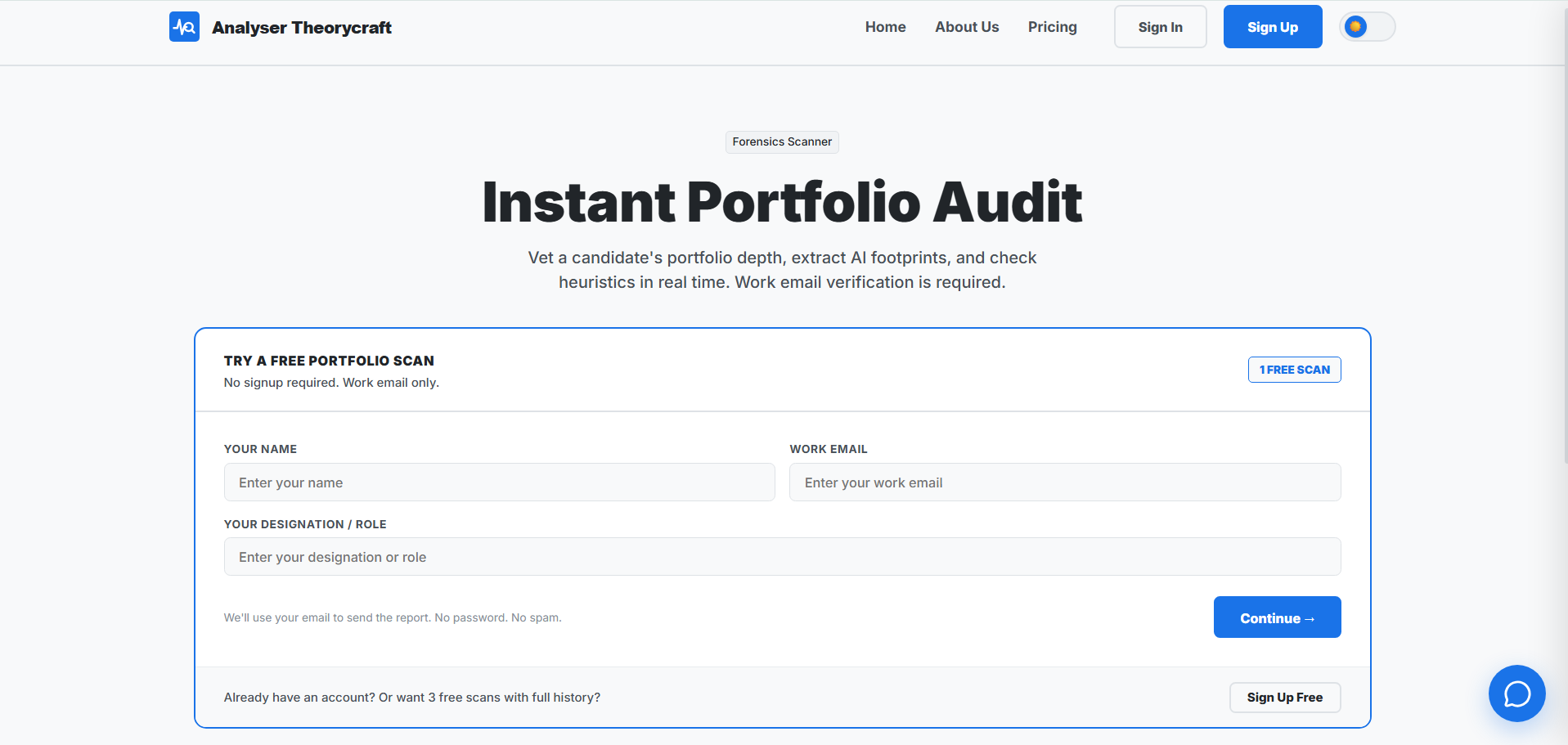
Generative AI has introduced a massive signal-to-noise crisis in tech recruiting. Portfolios are now filled with flawless, AI-written templates and perfect strategic prose, masking actual developer capability. We built ATC to serve as a forensic trust layer, analyzing submissions to isolate genuine iteration from template boilerplate.
The core engine runs a specialized scraper that crawls portfolio repositories and live sites, feeding text and assets to a local NLP classifier. The interface deconstructs this metadata into a single-glance scorecard containing an Authenticity Score and a Calibrated Craft Score.
ATC doesn't just scan resumes. It preserves human craftsmanship by forensically analyzing design grit.
— RECRUITMENT DIRECTOR, B2B SAAS SCALE-UPAuditing candidate sites at scale introduced major engineering and compliance friction. Recruiters need near-instant summaries, but scraping complex single-page apps (SPAs) and running NLP categorization is highly resource-intensive. We addressed two system bottlenecks.
SPA Client-Side Rendering Bottlenecks
Standard scraper scripts fail on modern React/Next.js client-side rendered websites, yielding blank documents. To bypass this, we implemented a serverless puppeteer browser cluster to execute JS before parsing text.
- High cold-start latency when launching headless browser instances
- DOM layout shifts causing misaligned text segmentation
- Robots.txt restrictions and automated cloudflare blocks on candidate portfolios
AI Prose Homogenization Classification
Separating academic design concepts from candidate-written case studies required fine-tuning a BERT classifier. Boilerplate design framework text (e.g. double-diamonds) needed to be filtered out without penalizing the candidate's actual narrative.
- High false-positives for junior portfolios using standard design terms
- Overlapping vector embeddings between AI-generated text and resume templates
- High context token cost when feeding full case studies to secondary LLMs
ATC proved that professional vetting must shift from passive key-value matching to active forensic validation. When AI makes it simple to generate polish, genuine technical grit becomes the ultimate differentiator.
The main engineering takeaway was the value of client-side caching. Headless scraping is slow and expensive. Caching candidate analyses in PostgreSQL using indexes speeds up subsequent views to zero latency.
By designing structured scorecards and pairing them with interactive UI blurs, we built a portal that recruiters trust and candidates respect.
Forensics requires evidence. Always ground AI classifications in documented revisions and wireframes.
Client latency kills utility. Cache expensive scraper outputs immediately.
Friction in candidate submissions can filter out low-intent spammers.
Be transparent with candidates. Provide actionable feedback letters to help them grow.
Scale is about APIs. Build modular parsers that can fit into existing enterprise ATS pipelines.
To verify candidate craft, the dashboard features a 'Human Grit Slider'. By sliding it from left to right, recruiters can dynamically blur template sentences and focus exclusively on core visual evidence, early wireframes, and design pivots.
Under the hood, this slider triggers css-driven classes that parse paragraphs labeled as 'template' or 'scaffold' by the NLP engine. Here are the core parameters used to determine the Grit score:
The proportion of standard template prose versus contextual case narrative.
Measures mismatch between strategic prose complexity and actual wireframe artifacts.
Tracks count of distinct editing sessions inside Figma documents via webhook API.
Specifies pages parsed to ensure complete analysis of a candidate's portfolio site.
The ATC Developer Sandbox allows engineers to inspect the JSON response returned by the NLP engine, simulating how candidate sites map to a forensic rating.
By displaying classification probabilities, token lengths, and scraping latency in a unified developer node, we debugged false-positive classifications before shipping to production.
interface ATCForensicsScore {
  candidateId: string;
  portfolioUrl: string;
  scrapingStatus: "completed" | "failed" | "rate_limited";

  nlpClassification: {
    authenticityScore: number; // 0.0 - 1.0
    calibratedCraftScore: number; // 0.0 - 1.0
    templateProseRatio: number; // percentage of boilerplate
  };

  figmaAudit: {
    connected: boolean;
    layersModified: number;
    uniqueSessionsCount: number;
  };

  telemetry: {
    scrapingLatencyMs: number;
    nlpProcessingMs: number;
    tokenCountParsed: number;
  };

  behavioralProbes: {
    probeId: string;
    targetClaim: string;
    suggestedQuestion: string;
  }[];
}Observability in vetting systems means tracing NLP scoring decisions back to the exact source paragraphs. Recruiters must see exactly why a score was marked as 'Boilerplate' or 'High Craft'.
System match rate validating manual hiring manager grading against automated ATC classification scores.
Minimizes screening leakage and ensures high-quality interview shortlists.
Scraper response speed when parsing candidate websites and resolving layout scripts.
Enables real-time scorecard generation on lead creation.
Total text tokens analyzed per portfolio page, excluding layout tags and styling wrappers.
Ensures model stays within budget limits and avoids context truncation.
Looking for a Strategic Design partner?
Whether it's orchestrating complex design systems or building agentic AI layers, I help organizations bridge the gap between business vision and user-centric reality.